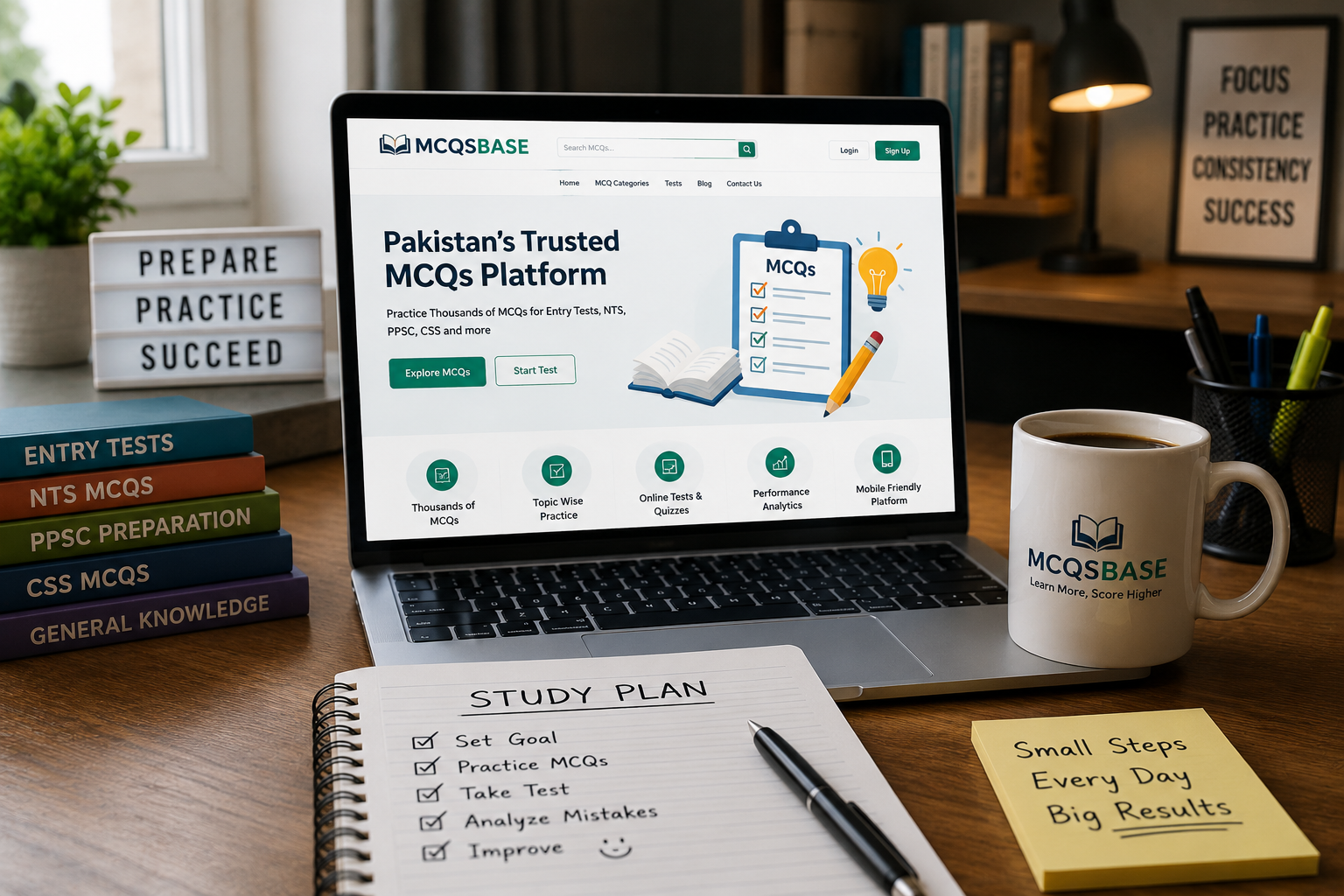
A practical study plan for PPSC, FPSC, SPSC, NTS, CSS screening tests, entry tests, and job exams in Pakistan
A focused MCQ preparation setup built around planning, practice, and progress.
A 30-Day Plan Beats a 30-Tab Browser
You sit down to prepare for an MCQ test. Five minutes later, you have twelve tabs open, three PDF books downloading, two WhatsApp groups arguing about the syllabus, and one video titled "100% Confirm Questions." Congratulations: you are now fully prepared for confusion.
The real problem is rarely a shortage of material. It is the absence of a repeatable system. Good mcqs test preparation should tell you what to study, how to practise it, when to test yourself, and what to do with every mistake. This guide gives you that system in 30 days.
The plan works for one-paper job tests, screening exams, university entry tests, and subject-based papers. You can adapt it for PPSC, FPSC, SPSC, NTS, CSS screening, teaching posts, police recruitment, banking tests, and similar exams. Start by confirming the official syllabus, then use the competitive-exam MCQ library, exam preparation articles, and past papers for Pakistan exams to turn that syllabus into daily work.
Learn a small topic, answer questions without notes, review why you were wrong, repeat weak areas, and finish each week with a timed test.
Why Random MCQ Practice Fails
Random online MCQs can feel productive because you are constantly clicking. But clicking is not the same as learning. A score of 70% tells you very little unless you know which topics produced the missing 30%, whether the errors came from weak knowledge or poor timing, and whether the same mistakes return tomorrow wearing a fake moustache.
Strong preparation combines four things: syllabus coverage, active recall, timed practice, and error analysis. The University of Melbourne explains that answering practice questions shifts revision from passive to active learning, while ACCA guidance stresses broad syllabus coverage, varied question practice, and a deliberate exam strategy. That is the difference between merely reading MCQs and training for an MCQ paper.
Before starting, read the relevant exam preparation articles and scan the ultimate guide to past papers. Candidates preparing specifically for NTS can also use the complete NTS preparation guide, while CSS candidates should verify the structure through the FPSC CSS exam pattern guide.
Step 1: Build Your Exam Map Before Day 1
Write the syllabus on one page. Do not start with books; start with the exam. Divide every subject into three labels: strong, average, and weak. Then estimate the likely weight of each area from the official syllabus and recent past papers.
- Strong topics: brief revision plus timed questions.
- Average topics: concept refresh plus regular topic-wise practice.
- Weak topics: short lessons, easy questions first, then mixed questions.
Use the General Knowledge MCQs, Pakistan Studies MCQs, Islamic Studies MCQs, English MCQs, and Everyday Science MCQs as separate practice lanes. The point is to know where you are going before collecting another mountain of notes.
Step 2: Take a Baseline Test
On Day 1, take a short mixed test of 50 to 100 questions under a timer. Do not revise first. This is a diagnostic, not a wedding photo; it is allowed to look imperfect.
Use the MCQsBase online quiz or choose questions from the full MCQ database. Record four numbers: score, accuracy, average time per question, and the number of guessed answers. Then tag each wrong answer as a knowledge gap, confusion between options, careless reading, or time pressure.
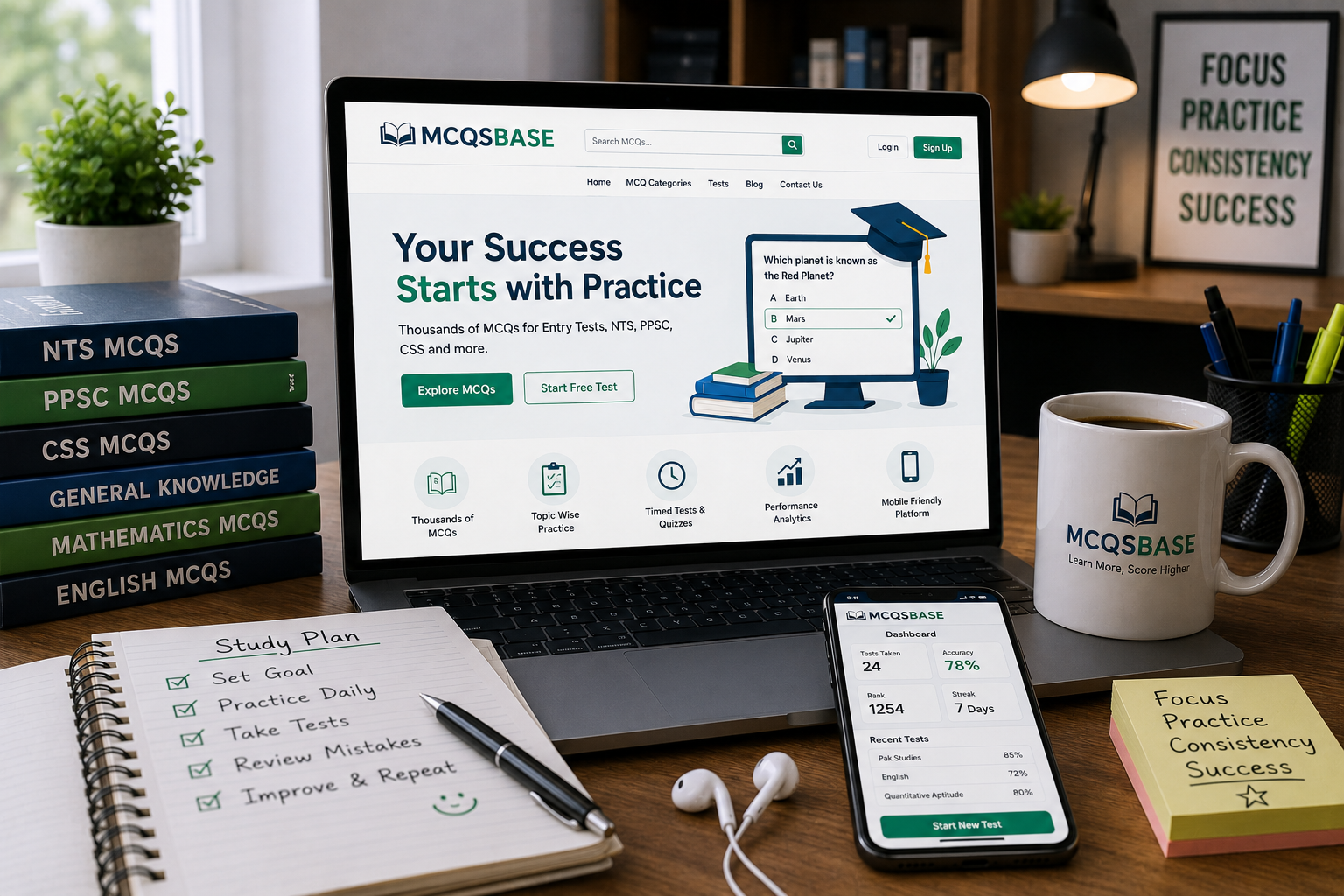
Timed tests and performance tracking turn practice into measurable improvement.
The 30-Day MCQ Test Preparation Plan
This schedule assumes 90 to 150 focused minutes a day. Candidates with more time can add a second subject block, but the sequence should remain the same. Consistency is the engine; heroic all-night study is mostly smoke coming out of it.
| Period | Main Goal | Daily Work | Weekly Check |
|---|---|---|---|
| Days 1-7 | Map the syllabus and rebuild foundations | Concept review, topic-wise MCQs, basic error log | One 50-question diagnostic retest |
| Days 8-14 | Increase coverage and recall | Two subjects daily, active recall, mixed revision | One 75-question timed test |
| Days 15-21 | Build speed and exam control | Timed sets, past-paper questions, weak-area drills | One full or near-full mock test |
| Days 22-30 | Simulate, analyse, and polish | Full mocks, rapid revision, repeated-error repair | Final two mocks plus light review |
Days 1-7: Foundation Without the Drama
Spend the first week covering high-frequency basics and learning how your mistakes behave. Choose one major area and one lighter area each day. For example, pair Pakistan Studies with English, or General Knowledge with Everyday Science. Use the Pakistan Studies preparation guide and English MCQ mastery guide when a subject needs more than question practice.
- Day 1: baseline test and syllabus map.
- Days 2-5: concept review followed by 40-60 topic-wise MCQs.
- Day 6: mixed revision and repeated-error practice.
- Day 7: timed retest, score comparison, and next-week adjustment.
Days 8-14: Turn Knowledge Into Recall
In week two, stop looking at the answer too quickly. Read the question, hide the options when possible, and try to produce the answer from memory. This prevents the familiar "I knew it when I saw it" illusion, the academic cousin of recognizing someone at a wedding but forgetting their name.
Add current-affairs revision through the current affairs preparation article, and use the Everyday Science topics guide to organize science revision. End Day 14 with a 75-question timed set and compare it with your baseline.
Days 15-21: Train Under Time Pressure
Now shorten the time allowed per question. Begin with small timed blocks of 20-25 questions, then combine them into longer sets. Use MCQsBase practice tests and review the guide on how practice tests improve exam performance. Your target is not reckless speed. It is calm speed: read correctly, eliminate weak options, answer, and move.
Bring in competitive-exam past papers during this week. Attempt them under realistic conditions, then use related topic pages for repair work. Past papers reveal the examiner's habits; fresh MCQs build the flexibility to handle new wording.
Days 22-30: Mock, Measure, and Polish
During the final nine days, reduce new material. Take full or near-full mock tests, inspect the error log, and revise only high-yield notes. Use the time-management strategies guide to refine pacing and the competitive exam success tips for final preparation discipline.
- Days 22, 25, and 28: full timed mock tests.
- Days 23, 26, and 29: deep review of wrong and guessed answers.
- Days 24 and 27: weak-topic repair plus short mixed quizzes.
- Day 30: light revision, exam logistics, sleep, and no panic-powered cramming.
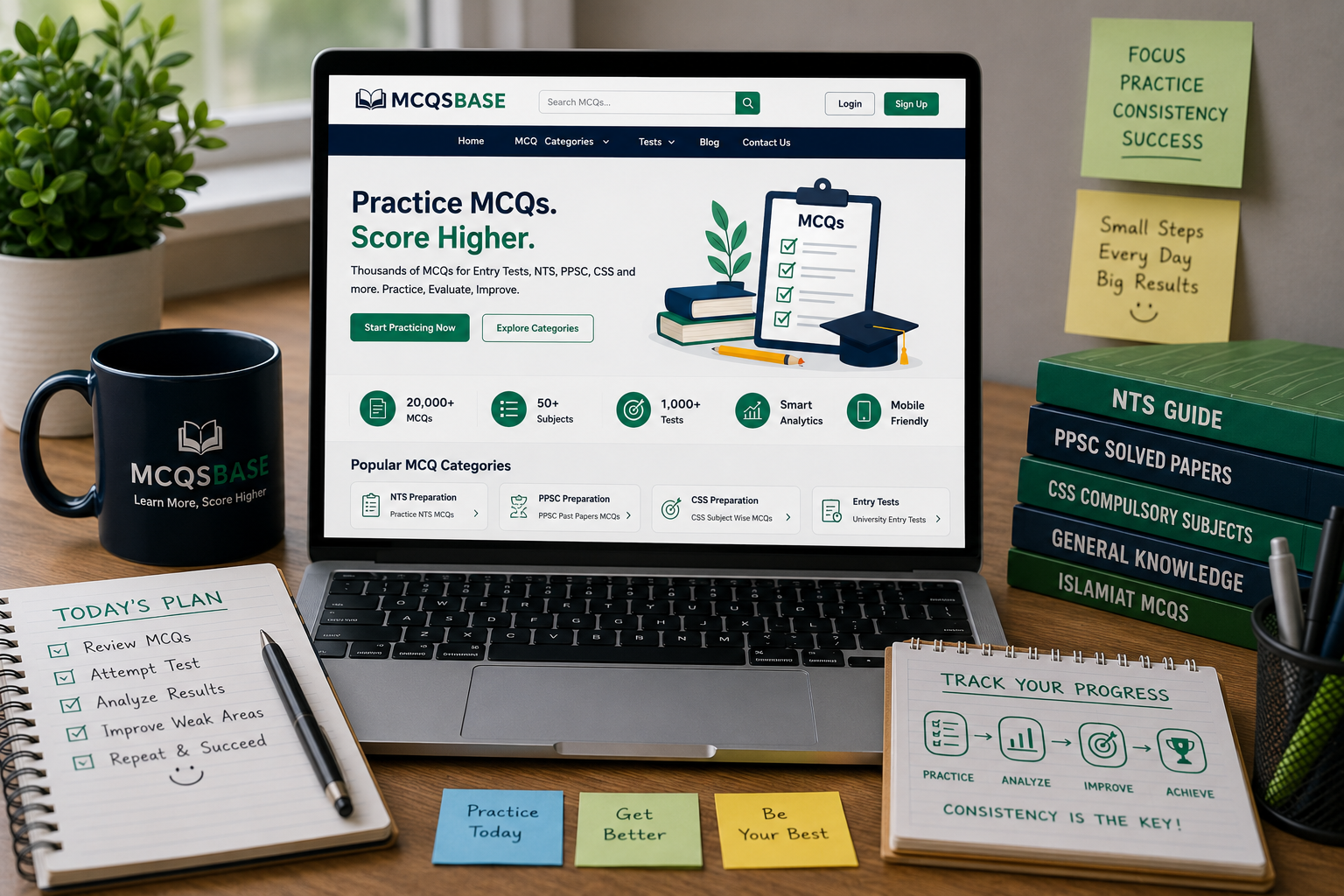
A simple daily study loop: practice, analyse, improve, and repeat.
Your Daily 100-Minute Study Loop
A fixed daily loop removes decision fatigue. You do not need to negotiate with yourself every evening like two politicians on a talk show. Open the plan and begin.
| Time | Task | Purpose |
|---|---|---|
| 20 min | Review one small concept block | Build understanding before testing |
| 30 min | Answer topic-wise MCQs | Strengthen recall and spot gaps |
| 15 min | Review wrong and guessed answers | Convert errors into lessons |
| 10 min | Re-attempt yesterday's mistakes | Use spaced repetition |
| 25 min | Timed mixed set | Improve switching, speed, and control |
Complete 20 questions, review every error, and re-attempt five old mistakes. A small completed session is better than an ambitious plan postponed until "tomorrow."
The Error Log: Your Most Valuable Study Material
Most candidates record scores. Strong candidates record causes. Create a notebook or spreadsheet with the question topic, your answer, the correct answer, why you missed it, and when to re-attempt it.
| Error Type | What It Usually Means | Fix |
|---|---|---|
| Knowledge gap | You never learned or forgot the fact | Review the concept, then answer 5-10 related questions |
| Option confusion | Two choices looked equally plausible | Write the distinguishing rule in one sentence |
| Careless reading | You missed words such as not, except, first, or most | Underline the command word before answering |
| Time pressure | You knew the method but rushed or froze | Practise smaller timed blocks and skip-return strategy |
Re-attempt mistakes after one day, three days, and seven days. When a question stays correct across reviews, retire it. When it keeps returning, promote the underlying topic to your weak-area list.
How Many MCQs Should You Practise Daily?
There is no magic number, but there is a useful range. Beginners can start with 40-60 carefully reviewed questions. Intermediate candidates can attempt 80-120. Advanced candidates close to the exam may complete 150 or more in mixed and timed blocks. Review quality matters more than a heroic count.
A student who attempts 60 questions and understands every mistake usually gains more than one who races through 300 and remembers only the emotional damage. Your daily target should rise only when accuracy stays stable.
Use Past Papers and Online MCQs Together
Past papers show what has been asked; online MCQs broaden what could be asked. The best approach is a loop: attempt a past-paper set, identify repeated subjects, practise fresh questions from those subjects, and then return to another paper.
The MCQsBase past-paper strategy guide explains how to attempt, analyse, map weak areas, and repeat. Pair that process with online MCQ practice instead of reading answer keys passively.

A learner follows a focused subject-wise plan instead of collecting random material.
Test-Day MCQ Strategy
- Read the instruction first. Confirm time, marks, and any negative-marking rule.
- Take the easy marks. Answer clear questions first and flag difficult ones.
- Eliminate before guessing. Cross out options that conflict with facts, grammar, units, or logic.
- Watch command words. Words such as except, incorrect, most, least, and first can reverse the task.
- Do not marry one question. If it is consuming too much time, move on and return later.
- Use the final minutes deliberately. Check flagged questions and answer-sheet alignment rather than changing correct answers from pure nervousness.
ACCA's MCQ guidance makes a sensible general point: candidates need preparation across the syllabus, experience with different question types, clear thinking, and a structured approach to the paper. Technique cannot replace knowledge, but it can stop poor pacing from stealing marks you already earned.
How to Choose an MCQ Website in Pakistan
Students use many search variations: mcqs websites in pakistan, mcq website, mcq site, mcq com, mcqs forum, mcqs base, and even mcq base. The useful question is not which phrase reaches the loudest page. It is whether the platform helps you practise systematically.
| What to Check | Why It Matters | Useful MCQsBase Route |
|---|---|---|
| Topic organisation | You can target weak subjects instead of scrolling randomly | All MCQ categories |
| Timed practice | You learn to answer accurately under pressure | Online quiz practice |
| Past papers | You see real patterns and repeated areas | Past papers archive |
| Interview support | Written-test preparation can continue into selection stages | Past interview experiences |
| Exam articles | A strategy keeps your resources connected | Exam preparation articles |
| Transparent mission | You understand what the platform is built to provide | About MCQsBase |
MCQsBase positions itself as a free platform with topic-wise MCQs, quizzes, past papers, interview experiences, and exam preparation articles. Its About page states that access is free and no registration is required, while the community contribution page allows users to submit questions for review. That combination makes it practical as a main hub for online test preparation, provided you still verify current syllabi and time-sensitive facts through official sources.
In other words, good mcq practice is not about finding endless online mcqs. It is about using a reliable mcq test routine to turn mcqs practice into better recall, speed, and judgement. A platform can supply the questions; your review process supplies the improvement.
A Quiet Lesson for Academies and Education Teams
There is also a wider lesson here. Students benefit when content, quizzes, analytics, follow-up, and progress visibility work as one connected system. Schools, academies, testing organizations, and education businesses planning a learner portal or automated communication flow may need more than a website, they may need the underlying workflow designed properly. That is the kind of systems-and-automation problem MoreTech Global works on for organizations that want cleaner lead capture, CRM structure, follow-up automation, and measurable digital processes. The technology should stay in the background; the learner's next action should stay obvious.
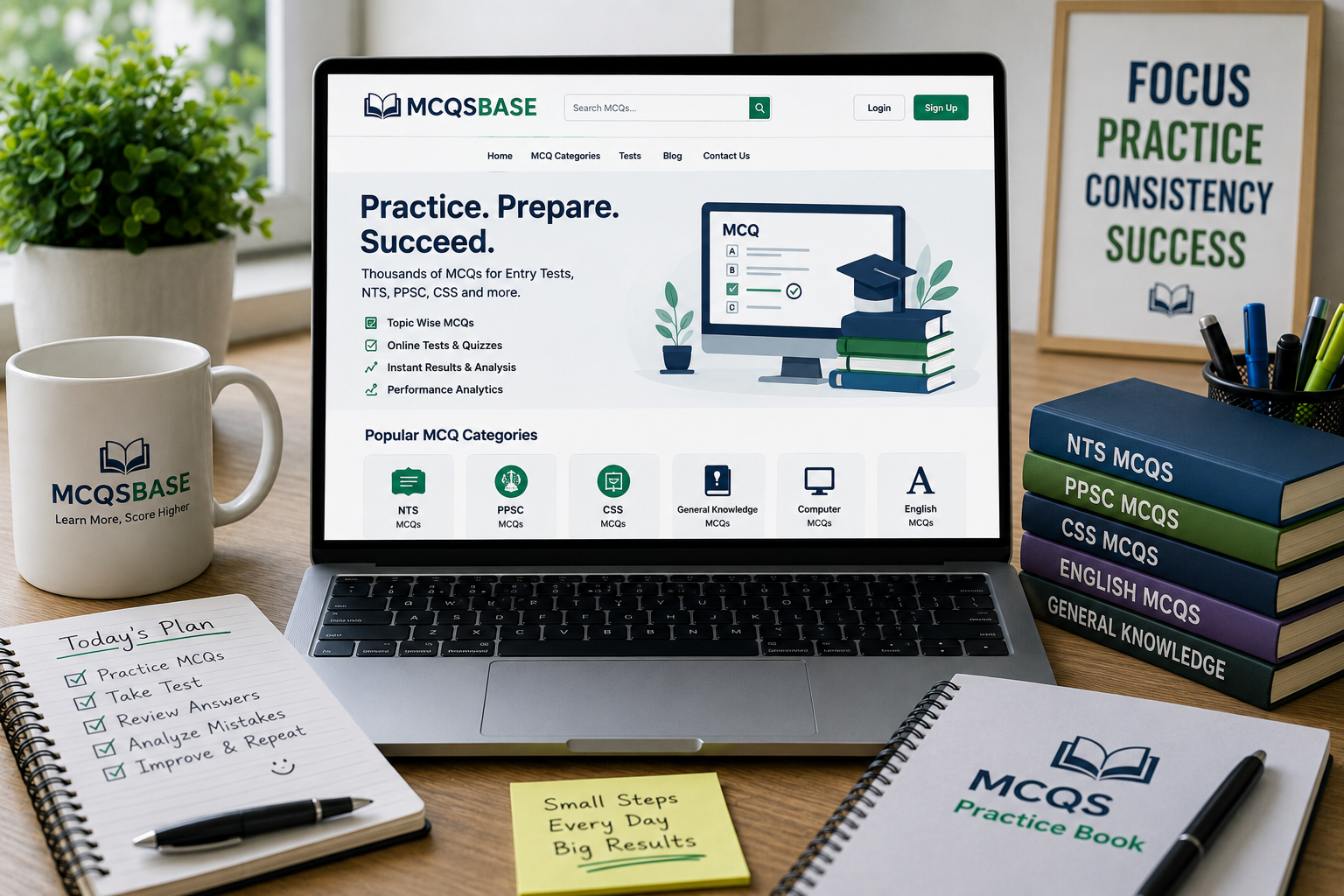
MCQsBase brings topic-wise MCQs, quizzes, past papers, and study guidance into one preparation routine.
Frequently Asked Questions
How do I prepare for an MCQ test?
Start with the official syllabus, take a diagnostic test, study one small topic at a time, practise questions without notes, review every wrong or guessed answer, and take timed mock tests each week.
What is the best way to study for multiple-choice exams?
Use active recall rather than rereading. Try to answer before viewing the options, explain why the correct option is right, identify why the distractors are wrong, and revisit mistakes after one, three, and seven days.
How many MCQs should I practise daily?
Begin with 40-60 well-reviewed questions. Move toward 80-120 as your accuracy improves. Near the exam, advanced candidates may attempt larger mixed sets, but review quality remains more important than raw volume.
How can I improve speed and accuracy in MCQ tests?
Practise short timed blocks, read the command word carefully, eliminate weak options, skip questions that are consuming too much time, and analyse whether errors come from knowledge, confusion, carelessness, or pacing.
Are past papers enough for competitive exam preparation?
No. Past papers are excellent for pattern recognition and high-frequency topics, but they should be paired with concept study, fresh topic-wise MCQs, current information, and full mock tests.
Should I guess an answer when I do not know?
First check the exam's negative-marking rule. When there is no penalty, elimination-based guessing is usually better than leaving an answer blank. When wrong answers are penalized, use a more cautious strategy.
Which MCQ website is best in Pakistan?
The best choice is a platform that offers organized subjects, relevant questions, timed practice, past papers, clear explanations or review support, and a distraction-light experience. McqsBase brings those preparation routes together in one free platform.
Can I prepare for competitive exams without an academy?
Yes. A clear syllabus, reliable books, official notices, past papers, online MCQs, and consistent mock testing can support effective self-study. An academy may provide structure, but the daily learning work still belongs to the candidate.
Start With One Session, Not a Perfect Month
A 30-day plan works because it replaces vague intention with visible actions. You know what to study today, how to test it, and what to fix tomorrow. That makes mcqs preparation calmer and more honest. You are no longer collecting material to feel prepared; you are producing evidence that you are improving.
Begin with a baseline test on MCQsBase, choose one weak subject from the MCQ category library, and complete your first review loop today. Thirty days from now, your browser may still have too many tabs, but at least your preparation will know where it is going.
Open MCQsBase online practice, attempt a timed set, and write down the first three mistakes worth revisiting tomorrow.
People Also Read
Continue with these recent MCQsBase guides and strategy articles:
- PakMcqs vs McqsBase - Why McqsBase is the Better Choice for Serious Exam Preparation (2026 Guide)
- Ultimate Guide to Past Papers for Pakistan's Competitive Exams (2026 Strategy)
- The Future of Digital Exam Preparation in Pakistan (2026 & Beyond)
- A Complete Guide to NTS Exam Preparation Tips (2026 Success Strategy)
- Why McqsBase is the Leading Platform for Pakistan's Exam Prep (2026 Guide)
- 2026's Best-Priced and Most Comprehensive MCQ Practice Resources (Pakistan Guide)
- How McqsBase's Practice Tests Help Boost Your Exam Success Rates (2026 Guide)
- Comparing Top MCQ Platforms for Pakistan Exam Preparation (2026 Guide)
- Why Online MCQs Practice Is Essential in 2026
- Best Resources for Interview Preparation in Pakistan's Public Sector Exams (PPSC, FPSC, SPSC)
- List of Best Free Resources for PPSC, FPSC, and SPSC Exams (2026 Guide)
For the complete archive, explore the MCQsBase exam-preparation blog.